Call Us Today on 01904 626388

Menu

Menu
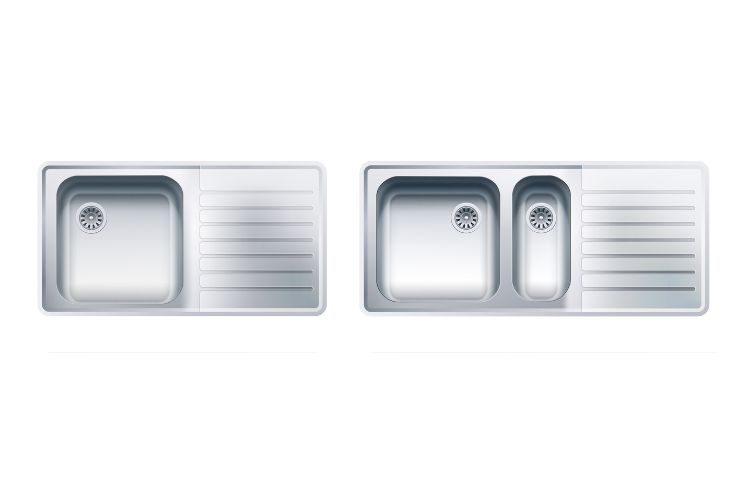
Choosing the right sink layout can have more impact on your kitchen than you might expect. It influences how you cook, clean and organise your space on a daily basis.
A common decision we help clients make is whether to choose a single vs 1.5 bowl sink. Both options are practical. Both work beautifully when planned properly. The key is understanding how you use your kitchen and how the sink fits within your wider layout.
Large capacity for trays and roasting tins
Clean, uncluttered appearance
Easier to wipe down and maintain
Often better suited to undermount installations
Works well in compact kitchens
No separate area for rinsing
May require a separate drainer or drying rack
Less natural separation of tasks
In open-plan kitchens, a large single bowl sink often feels sleek and understated.
A 1.5 bowl kitchen sink is the most popular choice in the UK market, particularly because it can fit within a 600mm base unit, making it a great option for smaller kitchens. These sinks combine the features of single and double bowl sinks without requiring additional space, offering both practicality and versatility. With two bowls (one main and one smaller) this configuration adds extra convenience to your kitchen setup.
The smaller section can be used for rinsing and swilling while the main bowl is in use, allowing for multitasking and making food preparation and cleaning more efficient. Thanks to this design, you can easily separate tasks, which is great for busy kitchens.
Separate areas for washing and rinsing
Flexible workflow when cooking
Practical for multitasking
Ideal for homes without a dishwasher
Slightly smaller main bowl
Requires more worktop width
Can look busier in minimalist kitchens
For some households, the additional bowl adds convenience that quickly becomes indispensable.
When comparing single vs 1.5 bowl sink, it’s often a question of simplicity versus flexibility.
If you cook frequently and from scratch, the workflow becomes important.
A 1.5 bowl sink allows you to:
Wash vegetables in one bowl
Drain pasta in the other
Keep dirty pans separate from food prep
This separation can feel more organised during busy meal preparation.
However, if you regularly wash large roasting trays or baking sheets, a deep single bowl kitchen sink can be more practical. There’s no dividing wall limiting space.
The best sink for cooking ultimately depends on what and how you cook.
Your overall kitchen sink layout plays a significant role.
A kitchen sink must be installed in specially designed cupboards for a secure fit and a neat finish. The order of sinks, cabinetry, and worktops is crucial to achieving a functional and aesthetically pleasing room.
Consider:
Worktop depth
Position relative to hob and fridge
Dishwasher placement
Whether you have a separate island
In compact kitchens, a single bowl sink often makes better use of limited space.
In larger kitchens, particularly those with generous worktops, a 1.5 bowl kitchen sink can enhance functionality without feeling crowded.
We always plan sink layouts alongside cabinetry and worktops to ensure the proportions feel balanced, resulting in a complete kitchen design.
This is often the deciding factor.
If you have a dishwasher and mainly use the sink for rinsing and occasional washing, a single bowl sink is usually sufficient.
If you do more handwashing or prefer soaking and rinsing separately, the extra bowl in a 1.5 layout can be genuinely useful.
Under-sink storage is often overlooked. Some under-sink cabinets provide plenty of space for storage and easy access to plumbing, allowing for straightforward maintenance or repairs.
A larger single bowl may allow for a more centralised waste system.
A 1.5 bowl sink may require slightly different plumbing positioning, which can affect drawer layouts beneath.
Planning this early avoids compromises later.
Ask yourself:
Do you regularly wash large trays or cookware?
Do you prefer separate areas for rinsing and washing?
How much worktop space do you have?
Do you have a dishwasher?
Does your kitchen lean minimalist or family-traditional?
There is no universally better option. The right choice is the one that supports how you live in your kitchen every day.
It can be difficult to judge bowl size and proportions from photos alone.
We design and install bespoke kitchens across York and the surrounding area. In our kitchen showroom, you can explore our collection of kitchen sinks and taps, where a wide range of products are fitted into real displays.
If you’re deciding between a single vs 1.5 bowl sink, we’d be happy to guide you through the options.
Visit our York showroom or book a design appointment to start planning your kitchen today.
In most modern homes with a dishwasher, a large single bowl sink is more than sufficient for everyday use.
It can be. The additional bowl allows separate rinsing and draining, which many home cooks find useful.
Yes. It typically requires a wider cabinet and slightly more worktop area.
In contemporary kitchens, single bowl sinks are increasingly popular. In family-focused kitchens, 1.5 bowl sinks remain a strong choice.
Boiling Water Tap: Is It Worth It in a Family Kitchen?
Stainless Steel vs Ceramic Sinks: Which Lasts Longer
Inset vs Undermount Sinks: Pros, Cons & Design Considerations