Call Us Today on 01904 626388

Menu

Menu
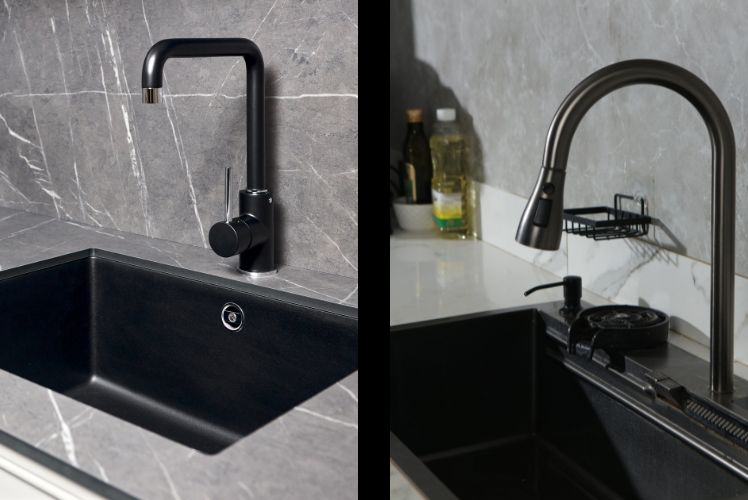
Choosing the right sink might seem like a small detail in the context of a full kitchen renovation, but it has a significant impact on both the look and practicality of your space.
Choosing between an inset and undermount sink is crucial for achieving the perfect fit and seamless integration within your kitchen or laundry space, ensuring compatibility and preventing future issues.
The answer, as with most things in kitchen design, depends on your kitchen worktop, your layout and how you use the space day to day. Below, we explore the differences between an inset vs undermount sink, along with the pros, cons and key design considerations to help you decide.
An inset sink (sometimes called a drop-in sink) is designed to sit into a cut-out in your worktop, with a visible rim or lip that rests on the surface. The edges are sealed around the cut-out to prevent water ingress.
Inset kitchen sinks are extremely common and work with a wide range of worktop materials, including laminate, timber and solid surfaces.
Compatible with most worktops, including laminate
Compatible with all worktop materials, including laminate, wood, and stone.
Typically more cost-effective
Straightforward fitting process
Often available with integrated drainers
Extensive selection of styles and materials
Visible rim can interrupt a seamless worktop look
Dirt and water can collect around the edge
Slightly harder to wipe crumbs directly into the bowl
An undermount sink is installed beneath the worktop. The sink is mounted from below, with the worktop edge exposed around the cut-out.
This creates a sleek, flush finish with no visible rim on the surface. An undermount kitchen sink is a popular choice for modern kitchens, especially when paired with quartz countertops.
Undermount sinks are most commonly paired with solid worktops such as quartz, granite, marble or solid surface, where the cut edge can be polished and sealed properly.
Undermount sinks are generally more expensive than overmount sinks due to their installation method and the need for solid surface countertops.
Key advantages of undermount sinks include:
Seamless, contemporary appearance
Easy to wipe crumbs and water straight into the bowl
No raised lip to trap debris
Enhances premium worktop materials
Often deeper than overmount sinks, providing more sound dampening.
Requires solid worktop (not suitable for laminate)
Typically higher installation cost
More complex fitting process
Structural support must be correct
An overmount sink is installed into a cutout in the countertop, with the rim resting on top of the surface. Overmount sinks are easier to install and replace compared to undermount sinks.
When weighing up inset vs undermount sink options, your worktop material is often the deciding factor.
If you are choosing laminate, timber or a budget-friendly surface, an inset sink is usually the most practical option. It’s important to match your sink choice to your countertop material, as certain installation methods work better with specific surfaces. Inset sinks are typically more budget-friendly and easier to install than undermount sinks, especially for laminate or timber worktops.
If you are investing in quartz, granite or a solid surface worktop, an undermount sink complements the clean lines beautifully. We often find that clients upgrading their worktops also lean towards an undermount to achieve that seamless finish.
This is why it’s important to consider your sink and worktops together rather than as separate decisions.
In busy family kitchens, practicality matters.
With an undermount sink, you can sweep crumbs and spills directly from the worktop into the bowl. There’s no raised edge in the way, which makes daily cleaning quicker. The seamless design of undermount sinks plays a key role in making cleaning easier, as there are no crevices for dirt to collect.
An inset sink, however, can feel more forgiving in certain situations. The rim can help prevent water spilling directly onto cabinetry, and many inset kitchen sinks include integrated drainers, which some families prefer.
Before starting the installation, gather the necessary materials and tools to ensure a smooth process.
Undermount sinks are typically:
Bonded to the underside of the worktop using specialist adhesives such as epoxy
Mechanically fixed with brackets or sink clips for extra support and stability
Fully sealed with silicone to prevent water ingress
The installation method may require securing the sink to the cabinet beneath the countertop for added stability
Installation steps for undermount sinks often include:
Cleaning the edges of the cutout and sink surface with denatured alcohol to remove any residue and ensure proper bonding
Test fitting the sink in the cutout to ensure a proper fit before securing it in place
Installing sink supports on thin countertops to provide necessary support
Applying epoxy adhesive to the rim of the sink before lifting it into the cutout
Positioning the sink accurately and using a bar clamp to hold the sink firmly in position while the adhesive cures
Using sink clips to secure the sink to the underside of the countertop
Applying silicone caulk around the sink rim for a watertight seal
Firmly pressing the sink into the silicone to ensure proper adhesion and to spread the silicone evenly
Connecting the plumbing system and checking all plumbing connections for leaks after installation
The installation of undermount sinks involves securely connecting the sink to the cut-out countertop, which can be time-consuming and may require a professional installer.
The worktop must be strong enough to support the weight of the sink, particularly with heavier materials like ceramic or composite.
Inset sink installation, often searched as fitting an inset sink, involves:
Cutting the correct aperture (cutout)
Dropping the sink into place
Securing it with clips
Sealing around the rim
Connecting the plumbing and ensuring all plumbing connections are watertight
While both can technically be installed independently, in a full kitchen renovation we always ensure the sink is fitted professionally to protect the cabinetry and worktops long term.
For traditional kitchens, Shaker styles or timber worktops, an inset sink often feels at home.
For contemporary, handleless or German-style kitchens, undermount sinks tend to enhance the clean lines and minimal detailing. Undermount sinks can also help maximize counter space, which is especially valuable in modern, minimal designs.
There isn’t a right or wrong answer. It’s about how the sink works within the overall design.
When comparing inset sink or undermount options, cost does play a role.
Inset kitchen sinks are usually:
Lower in product cost
Simpler to install
Compatible with more affordable worktops
Undermount sinks:
Often sit within more premium schemes
Require solid surface materials
Involve more detailed installation
However, in the context of a full kitchen project, the difference is often less significant than expected.
Longevity is more about material than mounting method.
Stainless steel, ceramic, granite composite and solid surface sinks are all available in both inset and undermount formats.
Provided installation is carried out correctly and seals are maintained, both types can last many years.
When deciding between an inset vs undermount sink, ask yourself:
What worktop are you choosing?
Do you prefer a seamless or defined edge?
Is easy cleaning your top priority?
Does your kitchen lean traditional or contemporary?
In many York homes, we see a mix. Period properties with timber worktops often suit inset kitchen sinks, while newer extensions and open-plan spaces frequently favour undermount options paired with quartz.
To help you make the right choice, refer to the steps outlined in this article for clear guidance on selecting and installing your ideal sink.
The easiest way to decide is to see both options fitted into real kitchen displays.
We design and install bespoke kitchens across York and the surrounding area. Our kitchen showroom allows you to compare inset and undermount sinks alongside different worktops, cabinetry styles and tap options, so you can understand how each looks and feels in practice.
If you’re planning a new kitchen and weighing up inset vs undermount sink choices, we’d be happy to guide you through the options.
Visit our York showroom or book a design appointment to start planning your kitchen with confidence.
An inset sink is a sink that sits within a cut-out in the worktop, with a visible rim resting on the surface. The rim is sealed to the countertop to create a watertight seal, ensuring no water leaks between the sink and the countertop.
Generally, yes. Fitting an inset sink is typically simpler because it drops into the worktop and is secured with clips and sealant. The installation process for undermount sinks is more complex, as they require precise alignment and secure attachment from below, making them best installed alongside solid worktops.
No. Undermount sinks require solid surface materials such as quartz, granite or solid surface. Laminate is not suitable because the exposed core would be vulnerable to moisture.
Boiling Water Tap: Is It Worth It in a Family Kitchen?
Stainless Steel vs Ceramic Sinks: Which Lasts Longer
Single Bowl vs 1.5 Bowl Kitchen Sinks: Which Is Right for You